
Fishing Cash with Kinect
by Dr. M
October 12 2016
Why This Article?
One day I started to look back and think what made our two versions of the Summer Fishing Game so successful in Osaka, Japan, and why Kinect was the perfect technology platform for creating great marketing value for a shopping mall.
I thought we got a couple of experiences worth sharing. In this article, I’ll do my best to describe they key factors for building successful Kinect apps for places like shopping malls and include a couple of tips and tricks for designers and developers of similar installations.
The Basic Idea
In 2015 I got a request from Igrek Design, a design house based in Osaka, to do all the programming of a Kinect-enabled Augmented Reality (AR) game that was going to be set up in a shopping mall for a summer sale event through the whole August.
Fantastic! So far I had built mainly business-to-business apps and research tools on Kinect, so entering the consumer space was something new and interesting to me. Not to mention the challenge of building a robust Kinect app remotely from my Malaysia base to Japan without having the exact matching hardware with the target venue.
So, our Summer Fishing Game was to enable the player to:
- Enter the game
- Catch some virtual fishes
- Get a discount coupon to be scanned with smartphone
- Use the coupon to get discount in nearby shops in the mall
You’ll get the point from the video made by Igrek Design:
Kinect 2 sensor locates on top of a vertically tilted man-size 1920x1080 resolution screen at about 2.3 meters. This makes the distance to each player typically at least 3 meters compared to Kinect’s maximum distance of 4 meters.
The Marketing Impact
We were fortunate to have a lot for our installation right in front of a convenience store surrounded by lots of other shops, so exactly everyone passing by will notice our game. The perfect spot! The combination of well-designed posters and exiting-looking Kinect installation catches the eye really well.
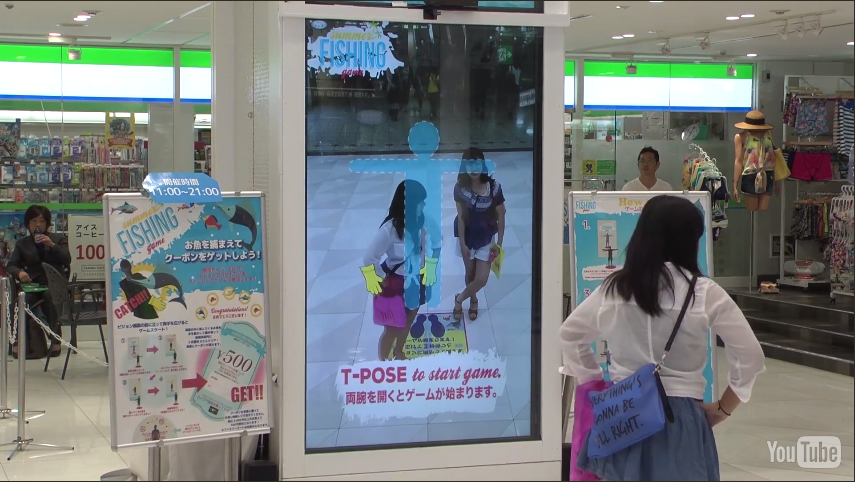
The posters helped to restrict the area for the player to avoid passers-by to enter the game accidentally.

And it didn’t attract only young folks familiar with this sort of technology.
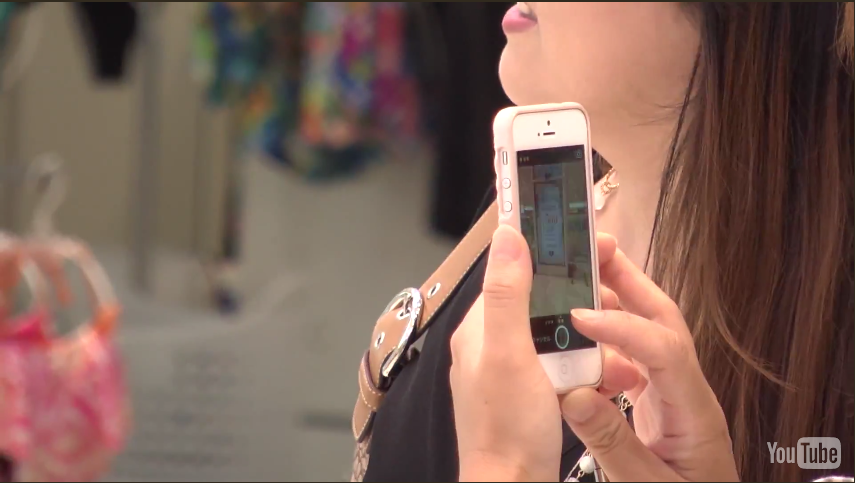
The use of a discount coupon as the prize was quite interesting from the beginning. In 2015 version we simply let the player to take a photo of the coupon labelled with a timestamp.
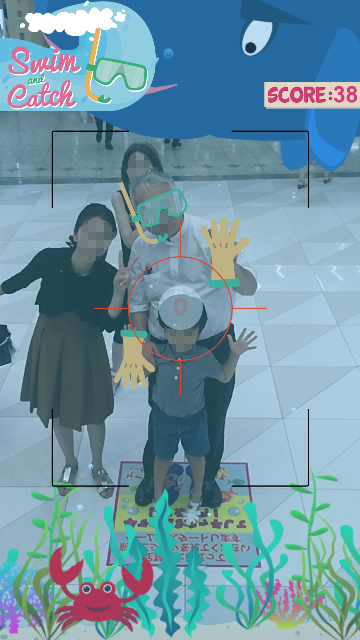
2016 version was implemented so that the player gets a selfie with all the AR props (implemented with just a screen capture), which is sent to a website.
Then, the game shows a QR code which the player can scan with the smartphone and land on a website which enables selection between a 100, 500 or 1000 yen coupon for different shops and downloading the photo. The most valuable coupon was available only after reaching certain score... something no player ever managed to get the first time. Almost everyone tried twice, since the game has a well-designed learning curve and price can get higher with better score.
In 2015 we did not count the number of games played but the actual coupons redeemed. This was about 10-15 each day, worth about 200 000 yen in total. Not so bad, in fact. In 2016 our game produced exactly 7345 coupons, meaning about 200 every day! This was total surprise to us and definitely made us to think of the real possibilities of this kind of marketing. It also means the total value of all the coupons is somewhere around 3-4 million yen. (Yet, we cannot disclose the exact number and total value of coupons that were actually redeemed.) Anyway, we can conclude that this sort of pure advertisement game can make real money circle around the neighborhood.
Technical Considerations to Game Design
1) Skeletal tracking distractors
For the 2015 version we spent days and days testing the gameplay and adjusting parameters that regulated the fish capture. Since Kinect cannot track exact specifics of each different player's hand movement from 3 meters away all the time.
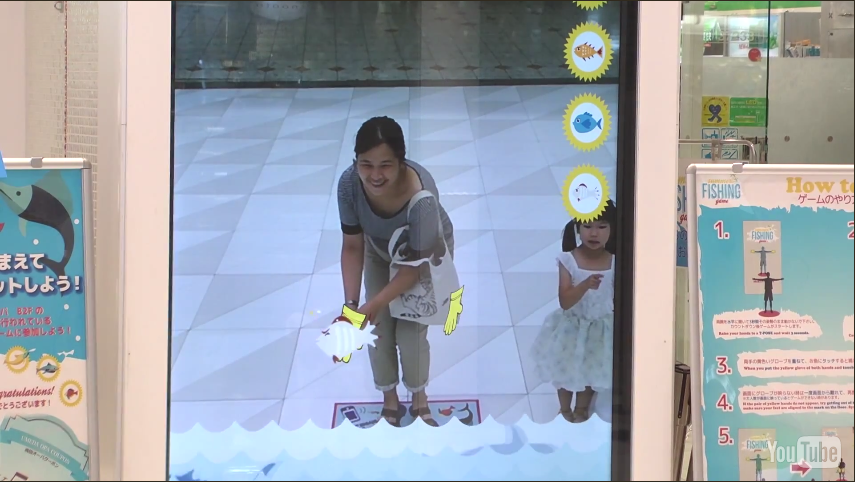
There are some hilarious moments when the AR glove appears in a lady's handbag right below the actual hand. Yet, the game works as intended!
Whatever is designed to be used in this kind of shopping mall environment has to be robust enough to handle all the variety of additional props and disturbances that in a normal Xbox setting at home would be considered as something on your troubleshooting list:
- Handbags or plastic bags full of newly bought stuff
- Hats, gloves and baggy clothes
- Fluffy hairstyles
All of this will be there and things should still just work. What I did is to go through the game several times with different clothes (here, especially shirts), holding bags and even pillows and tried to find practical limitations of what props would ruin the gameplay. Eventually, I ended up just limiting a minimum distance to recognize a bimanual catch gesture:
- At least 25cm distance from the torso to either hand on the Z axis, both joints being fully visible and tracked
- Object collision with one of the gloves and the fish
That gave wide enough space for recognizing the gesture. Yet, false positives were minimal since the standing normally won’t trigger the gesture. The most important improvement was the latter item. A conventional programmer would probably pick the obvious choice: both gloves should collide with the fish object. But this is where a lot of testing needs to be done. My first implementation with this approach completely failed even my own tests, since there is too much variability in tracking hands in rapid movements: tracking state can become Not Tracked and trajectory can vary a lot when hands are closed at the end of the movement. Yet, without the distance rule, catching the fish would become far too easy. One could just hold the hand in the middle of the jumping trajectory which would kill all the fun.
The third and final implementation was then actually simpler than the previous two, yet more robust. Usually I try to accommodate different body sizes in all distance calculations, but the third implementation seemed to work well with kids too so I could keep the gesture rules simple. Eventually, once a good balance between different parameters was found, we decided to let the rest go and realized that much of the real-world disturbances can actually be used as randomness factor in the game. Why not! As far as anyone can catch some fish, almost all people seem to be amused enough to go through the game a second time.
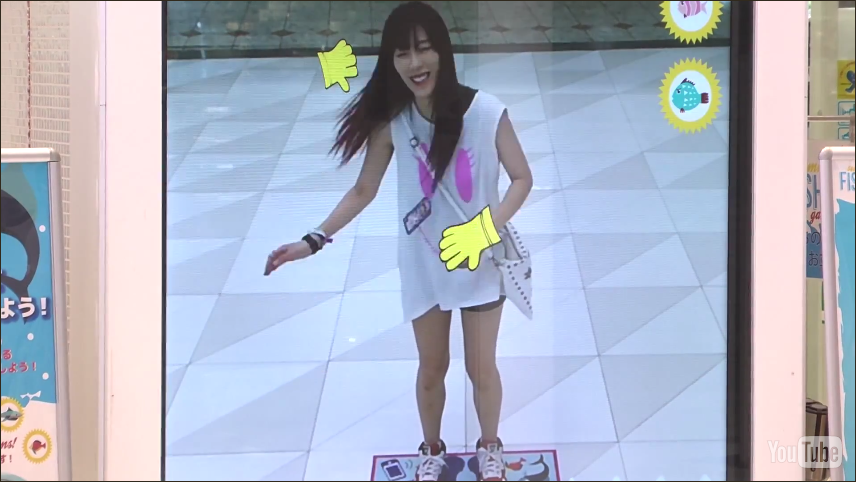
Even cases where the person’s hair and rapid hand movement around the head causes skeletal tracking to mix hand with hair didn’t seem to have much negative impact on the fun. As soon as Kinect resumed to track the person normally, which is a second or two later, the game can go on as usual.
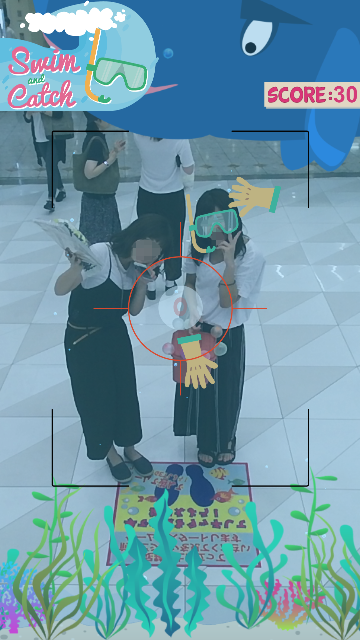
Funny tracking issues didn't seem to bother in the photo taking either. Actually, it started to feel like some deliberately tried to make all the funny poses to mess things up. I suppose it is a natural tendency in human behavior.
In the 2016 version the fishes just pass by on different height around the user. In this case, simple object collision between any of the gloves and the fish was quite enough. The fun part and the factor we spent most time testing was the amount and speed of the fish to make the game non-trivial. Even if the player stayed in a static pose to simply block the fish’s path, maximum score could not be produced. This was a rather easy implementation.
2) Start pose
Advantages of having a start pose to identify the active player is still a bit fuzzy in my mind. On one hand, since Kinect does not really require any calibration pose typical to all other similar technologies, it is not needed for any technical reason. However, making a simple T-pose makes it very clear in the first-time player’s mind when the game starts. In the 2015 version we did use the T-pose with 3 second countdown, partially because of the customer’s request. This worked just fine and the visuals make it obvious to anyone to figure out how to start the game. But, it takes those 3 seconds + transition to the next state in a situation where the game could be launched straight away.
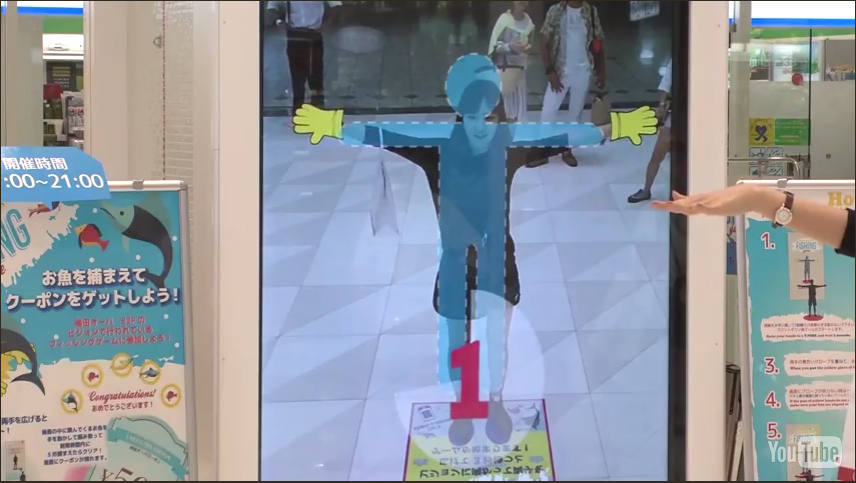
In 2016 we didn’t: we just showed the AR glove and diving gear overlays and let Kinect do the rest. Both worked just fine from both technical and player perspective! The only thing to mention here is to note that if any start pose is not used, the game needs to display something immediately once the user is recognized. AR props with an appropriate sound effect work as well as a pre-defined start pose.
Perhaps after seeing both options working well, I might incline more on the side of not using a start pose. It works if the game area is restricted appropriately. In a completely open space using a start pose makes more sense. Which brings us to the next topic.
3) Game area
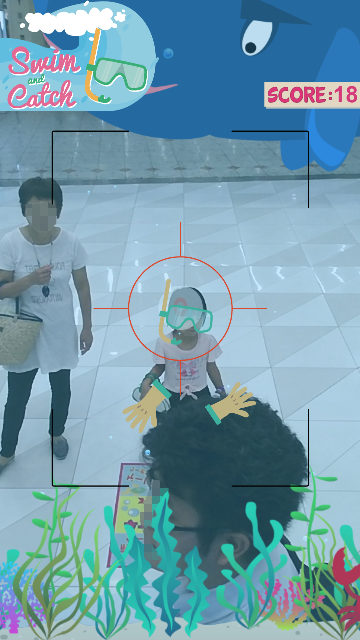
In a public space like this, restricting the game area on the floor is a must.Passers-by must not be let inside the game area, although sometimes it is inevitable.
Whereas the area is pretty obvious to set computationally in terms of distance from the sensor (here, 3 meters), we went through at least 3 test iterations of defining the correct horizontal limit. What needs to be tested is the scenario of 2-3 friends playing the game and standing close to each other. The safe limit is about arm's length on both sides of the player. This process ended up with simply limiting the player's base position as -60cm to +60cm from in the X axis of Kinect's coordinate system (to do really well it would be fit to the player's size instead of fixed amount of centimeters). A clear marker on the ground makes staying in the game idiot-proof. Well, almost!
4) Human factors
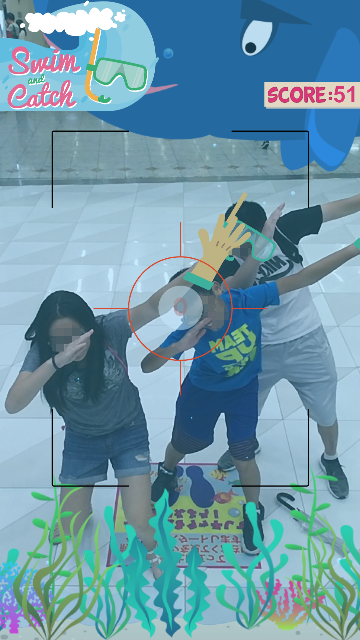
And for a function resembling taking a selfie, we must assume people will do all the funny things, alone or as a group, since the game is just for fun stuff anyway. It didn't work at all as we intended, but it didn't seem to stop anyone from having fun!
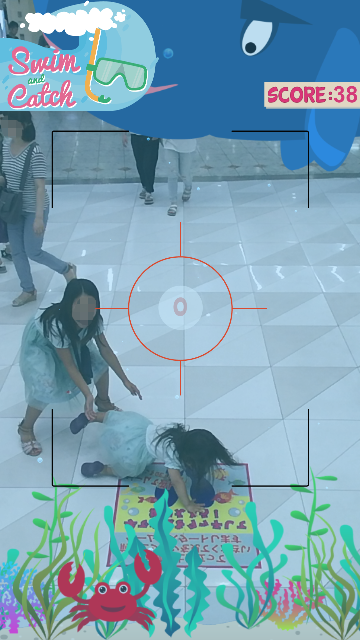
And sometimes the unthinkable happens even in the player's mind. The fish painted on the carpet are not for eating!
Conclusion
After explaining all this, I’d like to highlight that designing and implementing even simple game concepts such as our two versions of the Summer Fishing Game require quite a bit of detailing, testing, re-development and re-testing to get it right. Gameplay design, gesture recognition, the physical space and rewards all have to come together very nicely. Yet, it can really pay off in terms of making a successful advertisement game capable of circulating serious amounts of money.
In case you happen to be interested in this exact or similar concept, don’t hesitate to make contact through LinkedIn. Go fishing cash with Kinect!
© 2014-2018 Improventions. All rights reserved
Created by MGWalton
Powered by Coconuts